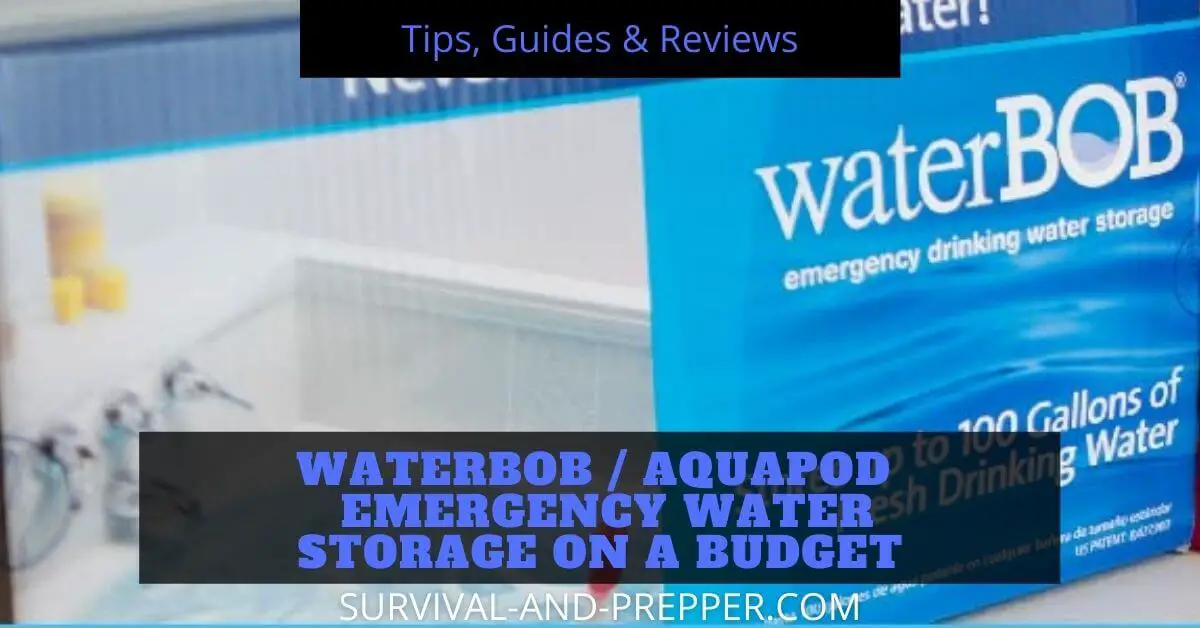
The Waterbob and Aquapod Large Quantity Emergency Water Storage
A Waterbob is a 100 gallon collapsible tank intended to store water for emergency situations. Unlike some other devices it is meant to be a temporary solution put in place just before a disaster event. They are relatively cheap and easy to store until needed.
Lets discuss the reasons why you may or may not want to purchase one for your emergency kit along with your food storage options.
NEW H2: WaterBob vs Aquapod Quick Comparison
| Feature | WaterBob | Aquapod 2.0 |
|---|---|---|
| Capacity | 100 Gallons | 65 Gallons |
| Intended Use | Emergency Water Storage | Emergency Water Storage |
| Reusable | Limited | Limited |
| Includes Pump | Yes | Yes |
| Storage Size | Compact | Compact |
| Best For | Maximum Water Storage | Easier Handling |
Check The WaterBob and Aquapod Price on Amazon
If you simply want the largest amount of emergency water storage possible, the WaterBob’s 100-gallon capacity is difficult to beat. However, many users prefer the Aquapod because the smaller capacity can make it easier to manage and drain after an emergency has passed.
How Large Capacity Temporary Container Is Intended to Be Used
A large capacity temporary water container is meant to be used only when you suspect that you will need it. Instead of storing water all the time like you would with a 55 gallon barrel or multiple smaller water jugs you only fill these containers when a threat is pending.
For example you know there is a hurricane or severe storm on the horizon and there is a potential you could either loose power and the ability to pump water or there is a concern that your water source could become contaminated then you would fill the temporary storage container at that time.
This should provide you enough clean water to last through most disasters until water could be restored. After all you can go several weeks without food if necessary, but only a few days with no water. So please consider water storage along with your food preps.
Here is a quick video to show you the setup of a waterbob.
What Is the Capacity of a Waterbob or Aquapod
The Waterbob is touted to have a 100 gallon capacity while the Aquapod lists its capacity at only 65 gallons. The Aquapod’s lower capacity is based off of their determination that the average bathtub only holds around 70 gallons of water if full. For safety reasons they opted for a container just smaller than that size.
Which Is Better: WaterBob or Aquapod?
Both products solve the same problem: quickly storing a large amount of potable water before an emergency. The WaterBob wins when maximum storage capacity is your primary concern. The Aquapod may be the better choice if you are worried about handling the weight of a completely full container or if your bathtub is smaller than average.
In most cases, families expecting long power outages or disruptions to municipal water supplies will benefit from the larger WaterBob capacity. Those looking for a simpler deployment may prefer the Aquapod.
How Long Can a Waterbob or Aquapod Store Water and Is It Reusable?
They suggest that by using an Aquapod or a WaterBob you can safely store large quantities of water for up to 16 weeks. However, both products are designed with a one time use in mind. They are primarily intended to be deployed for a pending emergency that you have some advanced warning of.
How Much Water Does a Family Need During an Emergency?
FEMA recommends storing at least one gallon of water per person per day for drinking and sanitation needs. A family of four should ideally have at least 12 gallons available for a three-day emergency and significantly more for longer disruptions.
A full WaterBob can provide enough water for a family of four for several weeks when used carefully, making it one of the most cost-effective emergency water storage options available.
What Are Some Pros of Using a Water Storage Device like the Aquapod or Waterbob?
Both of these devices provide have quite a few pros to their use. These include some of the following to list a few:
Pros to Using a Waterbob or Aquapod
- Compact storage when not needed
- Capable of very large volume of water storage
- Protects emergency water supply from contamination
- Relatively low cost
- Easy to use
- Contains a hand pump to transfer water to smaller containers
Check Other user Reviews for The WaterBob and Aquapod on Amazon
Are There Any Downsides?
As with any review it would not be complete unless I mentioned potential issues with these products.
Cons to Using a Waterbob or Aquapod
- One time use design
- Require advance notice of the disaster to be properly deployed
- A Lack of structural support requires the use of a bathtub
- Difficult to drain
Thoughts after Using the Waterbob
Why I Used It
I live in the Southeast and the area around my home is prone to flooding, in past years these floods have contaminated both wells and city water supplies for several days after the flooding.
While we do store drinking water separately, I have four children which requires quite a bit of water for things such as toilet use, dishes and other cleaning tasks. Because of this I wanted to be able to store additional water if I saw a reason to hunker down. I purchased a Waterbob in 2015 and stored it in my garage for this purpose.
One thing I appreciated was that it required essentially no maintenance while stored. Unlike water barrels or containers that need periodic cleaning and rotation, the WaterBob simply sat on a shelf until I needed it. For many people this may be one of its biggest advantages because it removes the need to constantly manage stored water.
In August of 2020 with the riots going on across the country and reports of Hurricane Laura approaching the coast I decided to dig out my Waterbob and fill it up.
Deployment
I chose the basement first due to concerns about storing that much weight for a significant amount of time and second as it would provide the strongest level of protection from storms or other threats. (My home is on a hill so not prone to flooding at my residence only the areas around it.)
I noticed a few things when I began to set up the Waterbob. The plastic is a bit thinner than I had expected but did not appear to have any damage or areas that would leak. I unfolded it and placed it in the tub. It was immediately apparent that the bag was larger than the tub and care had to be taken to position it in the middle.
When I began to fill the bag I had to keep an eye on it as the plastic would frequently crease and begin spraying water out of the top of the fill spout. However, once filled everything seemed secure enough and the water did not attempt to force its way out of the inlet. This task was completed sometime around August 20th, I don’t remember the exact date.
Removal and Disposal
In mid October I decided to drain the Waterbob and get rid of it. We had not ended up needing to use any of the water.
The first thing I noticed when I went to drain the bag was that there was no way to easily get the water out. Initially I intended on trying to dry it out and save it. So I had planned to just push the side down and let the water flow out like a swimming pool. However when I attempted this the water flow was minimal as it wanted to remain inside of the Waterbob.
Additionally due to the extreme weight (60 gallons of water at around 8lbs per gallon) the water was unable to pass the Waterbob and reach the drain.
My next thought was to pump the water from the Waterbob into the sink using the included hand pump. However, this ended up not working due to the sink sitting to far from the bathtub.
Finally I just punctured the top of the bag with a knife and then made a cut in the bottom inline with the drain. I guess that was why mine was truly a onetime use.
Despite that, I have seen reports of people using either apple cider vinegar or a small amount of bleach to sanitize the inside of the bag. Then drying it out using a shop vac, hairdryer or some other methods and I suppose you could do that. But with the price being as low as it was I did not mind replacing it. The peace of mind it provided even though we did not end up needing the water was worth the cost.
What I Would Do Differently Next Time
After using the WaterBob, there are a few things I would change if I were deploying one again.
First, I would place additional containers nearby before filling the bag. This would make it easier to transfer water if I decided to empty it later.
Second, I would test the included hand pump before an emergency. While the pump works, the distance to the final destination can make draining slower than expected.
Finally, I would consider whether the larger WaterBob capacity is necessary for my situation. For some households, the smaller Aquapod may be easier to manage while still providing ample emergency water storage.
Would I Buy It Again
I noticed that the Aquapod 2.0 is very similarly priced and that it is intended for 65 gallons. I think this might help with some of the issues that I had using the Waterbob and while I would definitely purchase a Waterbob again if there was not another option, I think I will try the Aquapod on my next purchase.
You can find both of these brands on Amazon by following these links. WaterBob and Aquapod
In addition to being able to store water, make sure that you are familiar with ways to purify or filter water if needed. Also check out our article on how long bottled water lasts.
Frequently Asked Questions
Can you reuse a WaterBob?
While the manufacturer generally considers the WaterBob a one-time-use product, some users have reported cleaning and drying them for reuse. Proper sanitation is critical if attempting this.
Is the WaterBob BPA free?
Yes, WaterBob products are manufactured using food-grade materials intended for potable water storage.
How long can water stay in a WaterBob?
The manufacturer recommends up to 16 weeks when properly filled and stored.
Can a bathtub hold 100 gallons of water?
Most standard bathtubs can support a filled WaterBob, but homeowners should always verify their tub’s condition and consult manufacturer recommendations if concerned.
Is WaterBob better than storing water bottles?
Water bottles are excellent for long-term preparedness, but a WaterBob allows you to quickly store a much larger quantity of water immediately before an emergency.




One Comment